
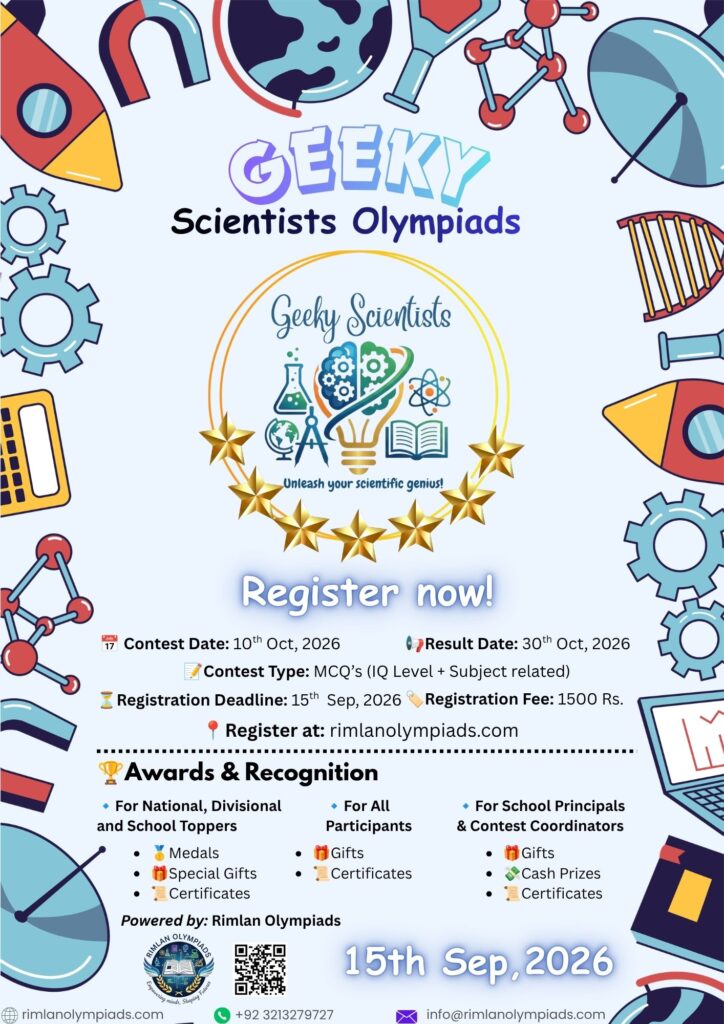
- All students from grade 1-10 are welcome to participate in the Rimlan Olympiads.
- The Rimlan Olympiads will be held simultaneously across Pakistan in participating institutions.
- Schools can host the Rimlan Olympiads by registering their students – open to all schools in Pakistan!
- We encourage maximum participation from both public and private schools.
- The contest will be in MCQs format, with a syllabus and sample papers provided.
- The contest will be held in-school with coordinator supervision.
- Certificates, medals, and gifts will be awarded to top students (national, divisional, school).
- Participation certificates and gifts will be given to all participants.
- Honorarium certificates, trophies, and special gifts will be awarded to school principals and relevant contest coordinators.
- Cash prizes will be awarded to contest coordinators/school based on participation:
- ➡ 5% of total registration fee for maximum participation of 20-40 students.
- ➡ 8% of total registration fee for maximum participation of 41-80 students.
- ➡ 10% of total registration fee for maximum participation above 80 students.
- The registration fee is Rs. 1500 per student, which covers the organizational costs.
- There is no registration fee for institutions.
- Students can participate in multiple categories.
- All schools can register through online portal on webiste.
Bank Name: Allied Bank Limited
Branch Code: 0084
Account Name: Rimlan Olympiads
Account Number: 0010160623380018
IBAN: PK31ABPA0010160623380018
1. Human Body
- Body parts
- Five senses
- Body care (food, exercise, sleep)
2. Plants
- Plants as living things
- Needs of plants (water, sunlight, air)
- Uses of plants (oxygen, food, shade)
3. Animals
- Animals as living things
- Animal homes
- Basic needs of animals
4. Matter
- Meaning of matter
- Examples of matter
5. Sound
- Meaning of sound
- How sound is produced
- Loud and soft sounds
6. Living and Non-Living Things
- Characteristics of living things
- Non-living things
- Differences between living and non-living things
1. The Human Body
- Body systems (skeletal, muscular, nervous)
- Five senses
- Personal health and hygiene
2. Plants and Animals
- Photosynthesis in plants
- Basic needs of animals
- Classification of living things
3. Food and Nutrition
- Nutrients and their functions
- Healthy food choices
- Importance of water
4. Matter and its States
- States of matter (solid, liquid, gas)
- Examples of states
- Changes of state
5. Force, Work, and Energy
- Force (push and pull)
- Concept of work
- Forms of energy
6. Transport and Communication
- Modes of transport
- Methods of communication
- Role of technology
7. Our Environment
- Living and non-living components
- Environmental care
- Reduce, reuse, recycle
8. Electricity
- Electricity as energy
- Electrical circuits
- Electrical safety
1. The Human Body: Anatomy – Facts and Functions
- Body systems and their functions
- Role of major organs
- System coordination for health
2. Structure and Functions of Plants
- Plant parts and roles
- Photosynthesis
- Respiration and transpiration
3. Classification of Plants and Animals
- Plant groups (monocots, dicots, gymnosperms)
- Animal groups (vertebrates, invertebrates, mammals, birds)
- Importance of classification
4. Force and Motion
- Concept of force
- Types of forces
- Motion (speed, velocity, acceleration)
5. Work and Energy
- Definition of work
- Forms of energy
- Energy transformation
6. Light
- Nature of light
- Properties (reflection, refraction, diffraction)
7. Sound
- Nature of sound waves
- Characteristics of sound
- Production of sound
8. Magnetism
- Magnetic force
- Poles of a magnet
- Electromagnets
1. Human Anatomy
- Body structure and functions
- Major body systems
2. The Cell
- Cell as basic unit
- Cell structure
- Cell functions
3. Microorganisms
- Types of microorganisms
- Importance and effects
4. Elements and Compounds
- Elements
- Compounds
- Examples
5. Acids, Bases, and Salts
- Properties of acids
- Properties of bases
- Formation of salts
6. Metals and Non-Metals
- Properties of metals
- Properties of non-metals
- Comparison
7. Friction
- Definition of friction
- Types of friction
8. Thermodynamics
- Heat and energy transfer
- Laws of thermodynamics
9. Electricity and Magnetism
- Electric current and circuits
- Magnetic fields and forces
BIOLOGY
1. Introduction to Biology
- Biology and its branches
- Biology relationship to other sciences
- Medical and environmental applications
2. Cell Biology
- Cell structure
- Cell functions
- Mitosis and meiosis
3. Classification
- Taxonomic hierarchy
- Five-kingdom system
CHEMISTRY
1. Structure of Atom
- Atomic and mass number
- Electron configuration
- Periodic table basics
2. Periodic Classification
- Metals, non-metals, metalloids
- Periodic trends
3. Chemical Reactions
- Types of reactions
- Balancing equations
- Stoichiometry basics
4. Electrochemistry
- Electrolysis
- Galvanic & electrolytic cells
5. Organic & Inorganic Chemistry
- Hydrocarbons & functional groups
- Acids, bases, salts
PHYSICS
1. Newton’s Laws of Motion
- First, Second & Third laws
- Force and acceleration
2. Work, Energy, and Power
- Concept of work
- Forms of energy
- Power formula
3. Electrostatics
- Electric charges
- Electric field
- Electric potential
4. Current Electricity
- Electric current
- Resistance and circuits
COMPUTER
1. Fundamentals of Computers
- Hardware & software
- Input, output & storage devices
- Generations of computers
2. Operating Systems
- Functions of OS
- Windows/Linux basics
- File management
3. Word Processing
- MS Word tools
- Formatting & editing
- Tables and graphics
4. Spreadsheets
- MS Excel basics
- Formulas & functions
- Charts and data management
5. Data Communication & Internet
- Types of networks (LAN, WAN)
- Internet services
- Email & web browsing
6. Cyber Security
- Computer viruses
- Malware & protection
- Safe internet practices